Similar Script or Rebuilt Script? Where the Line Actually Sits
Two channels cover the same subject in the same week. One of them is a normal thing that happens on a platform where millions of people make videos. The other is a copy. From the outside they can look almost identical, and the difference decides whether a channel is still there in two years.
This is worth being precise about, because the vague version — “add value”, “make it your own” — is advice nobody can act on at eleven at night with a deadline. So here is where I think the line actually sits, after nine years of making videos and a lot of time spent studying other people’s.
The phrase that matters is reused content, and it is not a synonym for “similar topic”.
What a similar script is
The default pipeline for a new creator looks like this: find a video with a lot of views, put it through a model, ask for a rewrite, change the pronouns, record it, publish. The whole thing takes an afternoon.
What comes out is a paraphrase. Same claims, same order, same beats, same pacing, different vocabulary. It is not usually a deliberate theft — it feels like work, because a lot of steps happened — but no analysis took place at any point. The model did a translation between two registers of English and nothing else.
You can spot it from outside the process. The opening resembles the source’s opening. The examples are the source’s examples. There is no position, no correction, nothing the writer noticed themselves. And it is fragile in a specific way: the video is only ever as good as the one it copied, and it has no reason to exist if the original is still up.
What a rebuilt script is
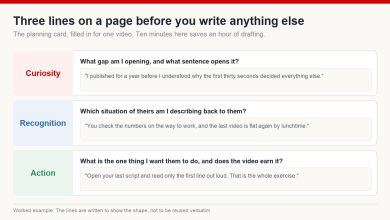
Same starting point — a video that clearly worked — and a completely different second step. Instead of asking what it said, you ask why it held people. Where does it withhold something. What does it explain first. Where does the attention dip and what does it do about it. What does it get wrong or leave out.
Then you build a different video on that skeleton, with your own material in it.
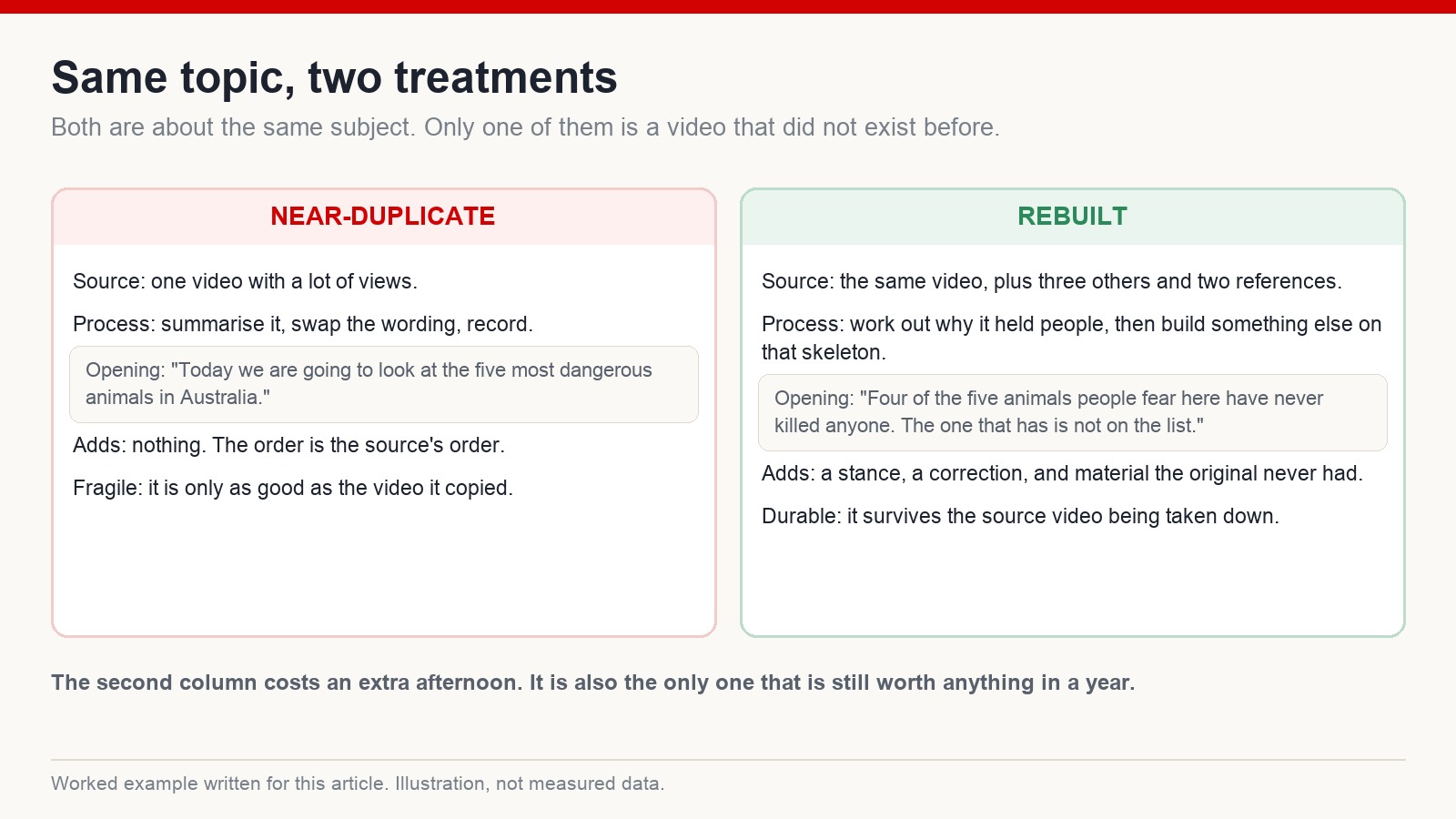
The two columns cost different amounts. The left one is an afternoon. The right one is an afternoon plus the reading, plus the argument with yourself about what you actually think. In a year only one of them is still worth anything.
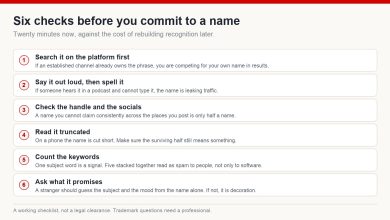
Five questions that settle it
Before a script gets recorded, run it through these. They take ten minutes and they are more useful than any amount of theorising about originality.
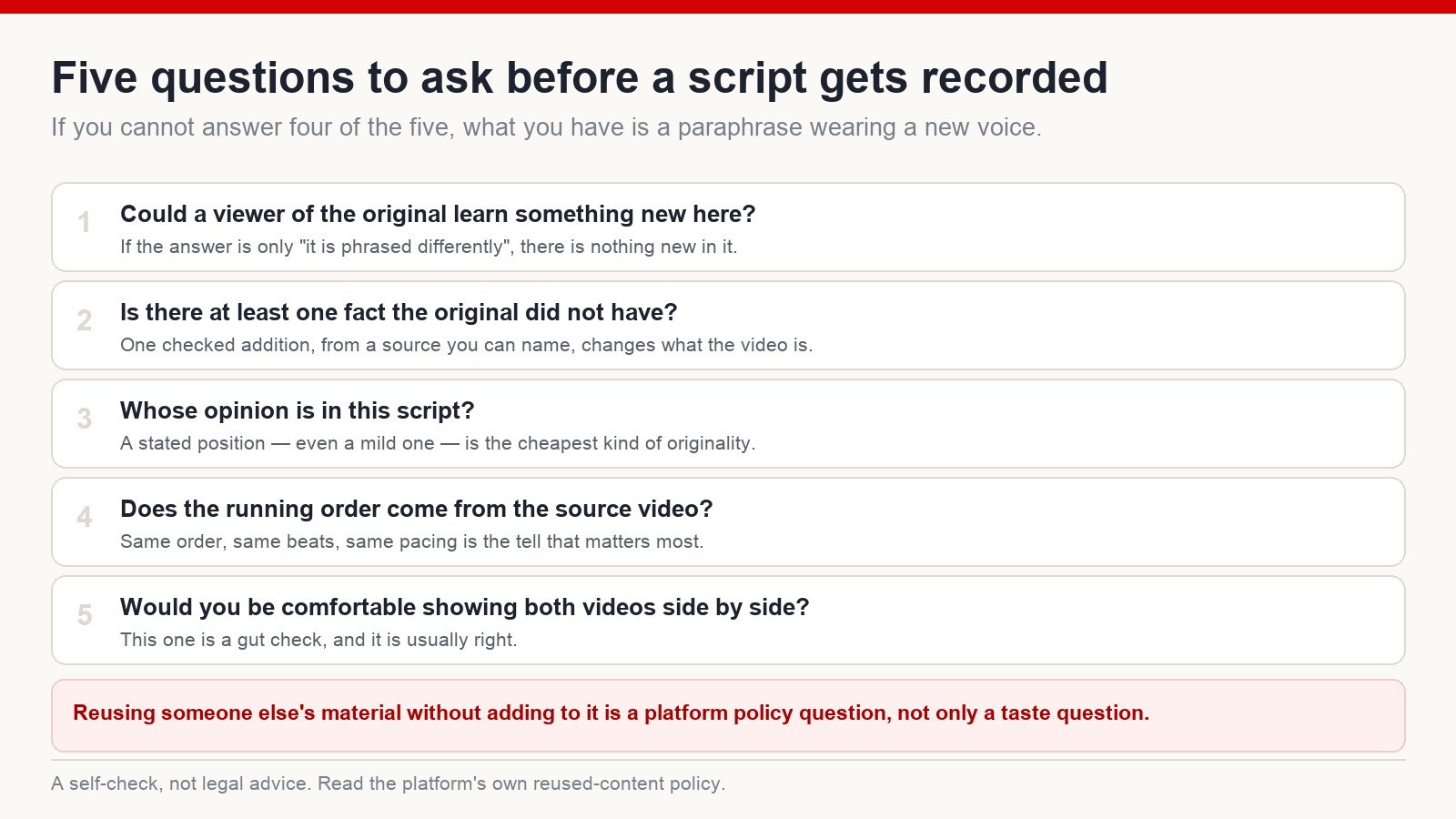
The fourth one does most of the work. Running order is the fingerprint of a script: two people who research the same subject independently almost never arrange it the same way. If your sequence of reveals matches the source’s sequence, everything else you changed is decoration.
The fifth is the one people skip because it is not analytical. Ask it anyway. If the idea of the two videos playing side by side makes you uncomfortable, you already know the answer.
Where to get raw material without taking anyone’s work
Studying a video is legitimate and it is how everyone learns. What you take from it has limits.
Fair to take: the structure. The observation that a question has to be answered before another one can be asked. The pacing. The realisation that a subject has an audience. The gap — the thing the video should have covered and did not.
Not yours: the script, the narration, the footage, the images, the thumbnail, the sequence of reveals, and the specific research if you are simply repeating it without checking anything.
Reading a public transcript to see how a video is built is fine. Lifting sentences out of it is not, and neither is downloading someone’s video and cutting your own from it. On that last point, one myth is worth killing directly: there is no “five second rule”, no percentage of a clip and no length of a quote that automatically makes someone else’s footage safe to use. That rule does not exist anywhere in copyright law or in platform policy. If you need footage, license it, shoot it, or generate it.
The policy dimension, stated plainly
Beyond taste, this has consequences. YouTube’s monetization policies require content that is meaningfully transformed or original — a channel built on republished or minimally altered material is at risk of losing monetization, and material used without permission can attract copyright claims and strikes independently of that.
The way this usually bites is not one bad video. It is a channel that publishes at volume with a near-duplicate process, does well enough for months, and then discovers the whole library is built on the same foundation at once. Nothing partial about that outcome.
I am describing my understanding of how the rules are applied, not giving legal advice, and the policies change. Read the current versions on YouTube’s own pages.
Covering a topic somebody else already covered
None of this means you have to avoid a subject because another channel got there. Most of what any of us make is a subject somebody has covered. The question is whether your version is a different object.
Three ways it usually becomes one:
- A correction. The popular video is wrong about something, or repeats a claim that does not survive checking. Say so, with the source.
- An addition. One fact, case or piece of context that was not in the original, from somewhere you can name.
- A position. An argument about what the material means. Mild is fine. Present is what matters.
Any one of those changes what the video is. Having none of them is what makes it a duplicate, regardless of how different the wording is.
Where the model belongs
All of this is compatible with using AI heavily. Ask it to break down what a successful video is doing structurally. Ask what it does not cover. Ask for the three most common objections to a claim. Ask it to draft a section you have already outlined, in the voice you have already defined, and then rewrite the parts that sound like nobody.
What you should never ask it for is the sentence “rewrite this video”. That single prompt is the difference between the two columns.
Frequently asked questions
Is it against the rules to make a video about the same topic as someone else? No. Topics are not owned. Scripts, footage and images are.
How different does a rewrite have to be? Different enough that it is a new work rather than a restatement — new information, a real perspective, an independent structure. There is no percentage that makes it safe.
Can I use a few seconds of someone’s video? Not automatically. Length does not decide it, and the rule people quote about a few seconds is not real. Commentary and criticism have their own legal treatment, which varies by country and is worth reading properly before relying on it.
Does AI-assisted writing count as reused content? Not by itself. Using a model to reproduce another creator’s video does.
Where to start
Take the last script you wrote from a reference video and answer question four honestly: did the running order come from you, or from them? If it came from them, rebuild the order from your own outline before you record. It is usually an hour of work, and it is the hour that makes the video yours.
If you want the whole research and scripting process behind this for faceless channels aimed at international audiences, it is at mmoyoutube.com. Policies change and results vary between channels.